





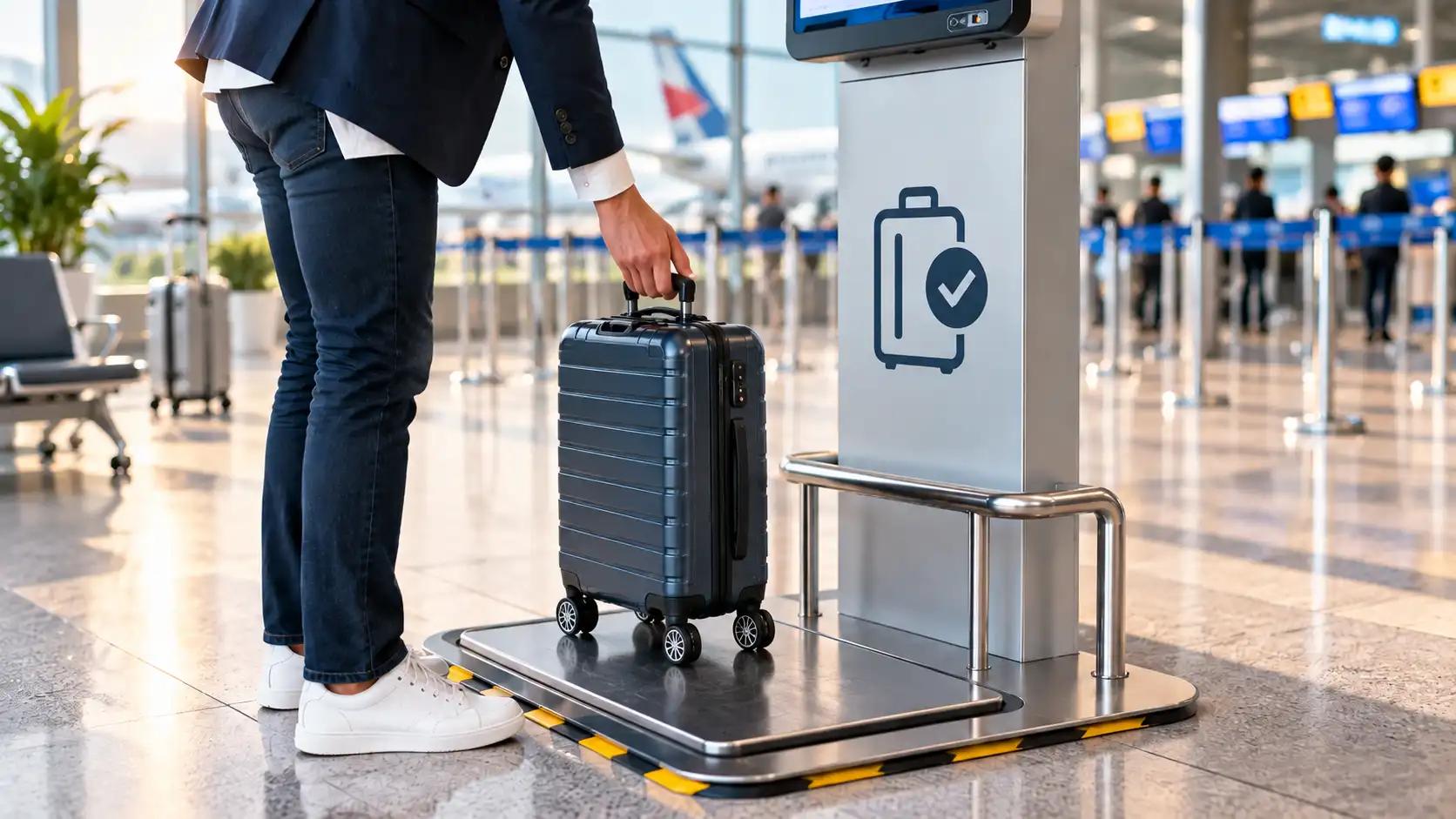
Standard Carry-On Luggage Size and Weight Guide
The bag may not have changed, but the rules attached to your ticket might have
You may have flown with the same suitcase several times without a problem, then suddenly be told at the gate that it is too large, too heavy, or not included with your fare.
That happens because there is no single standard carry-on luggage size that every airline follows. Your carry-on luggage size, weight limit, and baggage allowance can change depending on the airline, fare type, route, and aircraft.
For many major U.S. airlines, 22 × 14 × 9 inches (56 × 36 × 23 cm) is a common carry-on limit, including wheels and handles. International airlines may use different cabin bag dimensions and may also set a specific carry-on weight limit.
So before you pack, check the rules for the airline you are actually flying.

$25 OFF on USA Domestic Flights
Book USA domestic flights with MyBestFly and enjoy $25 OFF. Use coupon code USA25 and save more on your flight booking.
Quick Summary
There is no universal standard carry-on luggage size for every airline.
A common carry-on limit among major U.S. airlines is 22 × 14 × 9 inches (56 × 36 × 23 cm), including wheels and handles.
International airline rules can be different, especially for weight, so always check your airline before traveling.
Your personal item size is usually smaller than your main cabin bag and must fit under the seat in front of you.
Your ticket type matters too. Some fares include both a personal item and an overhead cabin bag, while others may have a more limited hand luggage allowance.
The Council currently describes the 40 × 30 × 15 cm personal-item provision.
Power banks must stay in carry-on baggage. New international guidance introduced in March 2026 limits passengers to two power banks for personal use and says they must not be recharged onboard, although airline and national implementation can vary.
Bag | Where it goes | Safe size to buy | Important Note |
|---|---|---|---|
Cabin bag | Overhead bin | 22 × 14 × 9 in. is common among major U.S. airlines | Check the exact airline limit |
Personal item | Under the seat | Size varies by airline | Must fit within the airline's personal-item rules |
In This Guide, You’ll Learn:
What is the difference between a carry-on and a personal item?
What is the standard carry-on luggage size?
Which carry-on rules apply to your trip?
What size carry-on do U.S. airlines allow?
What are the carry-on weight limits on international airlines?
What are the carry-on rules by airline in Europe?
What does the new EU hand luggage rule actually mean?
How many power banks can you take in your carry-on?
Which cabin bag dimensions work with the most airlines?
How can you avoid a gate check fee?
Which Carry-On Rules Should You Check?
The rules you need depend mainly on the airline you are flying and the fare you booked.
Flying with a U.S. airline? Start with the U.S. airline size table below.
Flying internationally with airlines such as Emirates, Qatar Airways, or Turkish Airlines? Check both the cabin bag dimensions and weight limit.
Flying with a European low-cost airline? Check what your fare includes, because a personal item may be included while an overhead bag costs extra.
Flying within or through Europe? The EU passenger-rights section explains the upcoming rules, but your airline's current baggage policy still applies.
Always check the baggage allowance shown with your own ticket before traveling.
What Is the Difference Between a Carry-On and a Personal Item?
A carry-on bag usually goes in the overhead bin, while a personal item must fit under the seat in front of you.
Cabin bag | Personal item | |
|---|---|---|
Where it goes | In the overhead bin | Under the seat in front of you |
Common examples | Small suitcase, larger backpack | Handbag, laptop bag, small backpack |
Size | Larger | Smaller |
Included with fare | Depends on the airline and ticket type | Often included, but check your fare |
Checked at the gate | May be measured or weighed | May also be checked on stricter airlines |
That split matters more than it used to. As cabin-bag charges have spread, your personal item size has become the thing that decides whether you pay anything at all.
What Is the Standard Carry-On Luggage Size?
A common standard carry-on luggage size in the United States is 22 × 14 × 9 inches (56 × 36 × 23 cm), including wheels and handles. However, there is no single size used by every airline.
That is why you should always check your airline's exact cabin bag dimensions before traveling.
What Size Carry-On Do U.S. Airlines Allow?
Airline | Maximum Carry-On Size | What to Know |
American Airlines | 22 × 14 × 9 in | One carry-on plus one personal item allowed |
Delta Air Lines | 22 × 14 × 9 in | One carry-on plus one personal item allowed |
Alaska Airlines | 22 × 14 × 9 in | Wheels and handles count toward the size |
JetBlue | 22 × 14 × 9 in | One carry-on included on current fares |
Southwest | 24 × 16 × 10 in | Larger size allowance than many U.S. airlines |
Frontier | 24 × 16 × 10 in | Maximum weight: 35 lb; carry-on may require an additional fee depending on your fare or bundle |
USA Domestic Popular Routes
Cheap Flights from New York to Washington
JFK to IAD
Cheap Flights from New York LaGuardia to Buffalo
LGA to BUF
Cheap Flights from LaGuardia to Washington
LGA to IAD
Cheap Flights from New York to Buffalo
JFK to BUF
Cheap Flights from New York to Fort Lauderdale
JFK to FLL
Cheap Flights from New York to Orlando
JFK to MCO
Cheap Flights from New York to Houston
JFK to IAH
Cheap Flights from New York to Toronto
LGA to YYZ
The 22 × 14 × 9-inch carry-on size is therefore a useful reference when buying luggage for U.S. travel, but it will not work as a universal rule for every airline. American, Alaska, and JetBlue currently publish that limit, while Southwest allows up to 24 × 16 × 10 inches.
Frontier also allows up to 24 × 16 × 10 inches, but the bag must weigh no more than 35 lb. One personal item is included, while an overhead carry-on may cost extra depending on the fare, bundle, or passenger status.
Always measure the bag at its widest points, including the wheels, handles, and any expanded compartments.
What Is the Carry-On Weight Limit on International Flights?
The carry-on weight limit on international flights varies by airline, but many major international carriers set Economy Class limits between 7 kg and 8 kg.
Airline | Economy cabin bag | Carry-on weight limit |
|---|---|---|
Around 55 x 40 x 23 cm | 8 kg | |
Around 55 x 38 x 22 cm | 7 kg | |
50 × 37 × 25 cm | 7 kg | |
Full-service European carriers | Commonly 55 x 40 x 23 cm | Commonly 8 kg |
Turkish Airlines currently allows one Economy cabin bag up to 8 kg, while Emirates and Qatar Airways allow one Economy cabin bag up to 7 kg. Their permitted cabin bag dimensions also differ, so checking weight alone is not enough.
A bag that passed on a US domestic flight with no weight check can be refused on an international carrier purely because it is heavy, even when it fits the size perfectly. Weigh your packed bag at home. If you are flying from New York to Dhaka with gifts, that check takes two minutes and saves a great deal of money at the counter.
Popular International Routes
Cheap New York to Dhaka Flights
JFK to DAC
Cheap Chicago to Dhaka Flights
ORD to DAC
Cheap Toronto to Dhaka Flights
YYZ to DAC
Cheap Miami to Dhaka Flights
MIA to DAC
Cheap Boston to Dhaka Flights
BOS to DAC
Cheap Houston to Dhaka Flights
IAH to DAC
Cheap Washington DC to Dhaka Flights
IAD to DAC
Cheap Philadelphia to Dhaka Flights
PHL to DAC
Cheap Dallas to Dhaka Flights
DFW to DAC
Cheap Atlanta to Dhaka Flights
ATL to DAC
Cheap Flights from New York to Madinah (JFK to MED)
JFK to MED
Cheap New York to Jeddah Flights
JFK to JED
Cheap Seattle to Dhaka Flights
SEA to DAC
Cheap Dhaka to London Flights
DAC to LHR
Cheap Dhaka to Riyadh Flights
DAC to RUH
Cheap Dhaka to Sydney Flights
DAC to SYD
Cheap Dhaka to Dubai Flights
DAC to DXB
Cheap Dhaka to Melbourne Flights
DAC to MEL
Cheap Dhaka to Kuala Lumpur Flights
DAC to KUL
Cheap Dhaka to Tokyo Flights
DAC to NRT
Cheap Dhaka to New York Flights
DAC to JFK
Cheap Dhaka to Singapore Flights
DAC to SIN
Cheap Dhaka to Guangzhou Flights
DAC to CAN
Cheap Dhaka to Dammam Flights
DAC to DMM
What Are the Carry-On Rules by Airline?
Carry-on rules by airline can vary significantly, especially for the size of the free under-seat bag and whether an overhead cabin bag is included in your fare.
Europe's low-cost carriers often have some of the strictest hand-luggage policies, and they may measure borderline bags at the gate.
Airline | Free under-seat bag | Overhead cabin bag | How to get the cabin bag |
|---|---|---|---|
Ryanair | 40 x 30 x 20 cm | 55 × 40 × 20 cm, up to 10 kg | Priority boarding or a Plus fare |
Wizz Air | 40 x 30 x 20 cm, up to 10 kg | 55 × 40 × 23 cm, up to 10 kg | WIZZ Priority or a Plus fare |
easyJet | 45 x 36 x 20 cm, up to 15 kg | 56 × 45 × 25 cm, up to 15 kg | Upgrade from the cheapest fare |
Ryanair and Wizz Air include a small under-seat bag with their basic fares, while a larger overhead bag requires an additional option. easyJet also includes one small under-seat cabin bag, with a larger overhead bag available separately or through certain fare benefits.
Size limits include more than just the main body of your suitcase. Handles, wheels, and overpacked sections can affect whether the bag fits within the airline's allowance.
A bag that is even slightly over the published limit may be refused, charged as an additional bag, or required to be checked at the gate. Rigid cases fail more often than soft ones, because a soft bag compresses in the frame and a hard shell will not give a millimetre.
Before flying, check the hand luggage allowance shown with your ticket rather than relying on the dimensions you used on a previous trip.
What Does the New EU Hand Luggage Rule Actually Say?
The updated EU passenger-rights framework provides for one personal item at no extra charge, with a reference maximum size of 40 × 30 × 15 cm or a requirement that it fit safely under the seat. However, travelers should continue following their airline's current baggage policy until the new rules become applicable.
Under the updated rules, the personal item can measure up to 40 × 30 × 15 cm, or it must fit safely under the seat in front of you.
What the New Rule Does | What It Does Not Do |
Gives passengers the right to one personal item at no extra cost | Does not create one universal overhead carry-on luggage size |
Sets 40 × 30 × 15 cm as the personal-item reference size, or allows an item that fits under the seat | Does not mean every ticket automatically includes a free overhead bag |
Requires clearer baggage information when fares are displayed | Does not replace each airline's own cabin-bag dimensions |
Was finally approved by EU lawmakers in July 2026 | Does not apply immediately |
The European Parliament approved the agreement on July 7, 2026, by 646 votes to 12, and the Council gave its final approval on July 13. The updated rules take effect 12 months and 20 days after publication in the EU's Official Journal, so travelers should continue following their airline's current baggage policy until the new rules become applicable.
Even after the new rules take effect, always check your airline and fare before traveling. The size of the personal item, the overhead cabin bag dimensions, and what is included in the ticket are not the same thing.
Did Airline Carry-On Rules Get Stricter in 2026?
For some travelers, yes. Several European airline groups introduced cheaper fare types in 2026 that include only a personal item and charge separately for an overhead cabin bag.
For example:
Airline Group | 2026 Change | What the Basic Fare Includes |
Lufthansa Group airlines | Economy Basic introduced for selected European routes | One personal item up to 40 × 30 × 15 cm; overhead carry-on available separately |
Air France and KLM | Economy Basic available on European routes | One small personal item; overhead hand baggage not included |
Lufthansa Group's Economy Basic fare is available on selected European routes for travel from May 19, 2026. It includes one personal item up to 40 × 30 × 15 cm, while a larger carry-on can be added for a fee. KLM's current Basic fare follows a similar approach, with one 40 × 30 × 15 cm small bag included and the overhead bag available separately.
So the important change is not that every airline has made its baggage policy stricter. It is that your fare type now matters more when checking your hand luggage allowance.
Before booking, check whether your fare includes:
one personal item only
a personal item plus an overhead carry-on
a carry-on weight limit
additional baggage charges
A small bag around 40 × 30 × 15 cm works within the personal-item allowance of several European airlines, but there is still no universal size that every airline must accept.
How Many Power Banks Can You Take in Your Carry-On?
Under the international rules introduced in March 2026, passengers can generally carry up to two power banks in cabin baggage, but individual airlines may set a lower limit.
ICAO introduced new power-bank restrictions on March 27, 2026. Power banks must remain in the cabin rather than checked baggage, and passengers must not recharge the power bank itself during the flight.
Rule | What to Know |
Where to pack it | Carry-on baggage only |
ICAO maximum | Up to 2 power banks per passenger |
Common capacity limit | Up to 100 Wh |
Charging the power bank onboard | Not allowed |
Using it to charge another device | Airline rules vary; some prohibit this too |
Airline restrictions | May be stricter than the general international rule |
Individual airlines can apply additional restrictions. For example:
Qatar Airways: up to 2 power banks, each no more than 100 Wh
Turkish Airlines: up to 2 power banks, each no more than 100 Wh
Emirates: only 1 power bank, no more than 100 Wh
Emirates also does not allow passengers to use a power bank to charge another device during the flight and requires it to remain accessible rather than in the overhead bin.
Before packing, check the watt-hour (Wh) rating printed on the power bank and confirm your airline's current policy. A power bank without a clear capacity rating may also cause problems during your journey.
How Do You Avoid a Gate Check Fee?
You can avoid a gate check fee by checking your airline's size, weight, and fare rules before you travel and making sure your bag fits them before you reach the airport.
Measure your bag at home: Include the wheels, handles, pockets, and any expanded sections when checking the carry-on luggage size.
Weigh it before you leave: This is especially important on international flights with a specific carry-on weight limit.
Do not overpack the bag: Even a bag that meets the published dimensions can become too large if the sides or pockets bulge.
Check what your fare includes before paying: Some basic fares include only a personal item and charge separately for an overhead carry-on.
Keep essentials in your personal item: If your cabin bag does need to be checked at the gate, you will still have medication, documents, electronics, and other important items with you.
If you are not sure which items should stay with you in the cabin, read our guide on what to pack in your carry-on luggage before you start packing.
A gate-checked bag goes into the hold, which means you may not have access to it again until baggage claim. That is another reason to keep valuables, medication, travel documents, and fragile items in your personal item.
The safest approach is to check the carry-on rules by airline before every trip rather than assuming a bag that worked on your last flight will be accepted again.
Carry-On Luggage Size: FAQs
Is a Backpack a Carry-On or a Personal Item?+
A backpack can be either a carry-on or a personal item, depending mainly on its size and where it fits. A smaller backpack that fits under the seat can usually count as your personal item. A larger travel backpack that needs to go in the overhead bin is generally treated as your carry-on bag. Check your airline's personal item size and carry-on dimensions rather than relying on the type of bag.
Can I Bring Duty-Free Shopping in Addition to My Carry-On?+
Sometimes, duty-free shopping does not automatically come with an extra baggage allowance. Some airlines allow a sealed duty-free bag in addition to your normal cabin baggage, while others may count it toward your existing allowance. If your bags are already at the limit, check the airline rules before making a large airport purchase.
Do Infants Get a Baggage Allowance?+
It depends on the airline, route, and whether the infant has their own ticketed seat. Some airlines allow additional infant items such as a diaper bag, stroller, or car seat without counting them against the adult's normal baggage allowance. However, an infant traveling on an adult's lap does not always receive a separate luggage allowance. Check the airline's infant baggage policy before you travel.
What Happens if the Overhead Bins Are Full?+
Your carry-on may need to be checked at the gate even if it meets the airline's size and weight rules. This can happen on full flights when there is not enough overhead-bin space for every passenger's bag. Keep medication, travel documents, electronics, valuables, and other essentials in your personal item so they stay with you.
Does My Carry-On Allowance Change With My Fare Class?+
Yes. Your hand luggage allowance can change depending on the fare you purchase. A bag may meet the airline's standard carry-on luggage size and still not be included with your ticket. Some basic fares include only a personal item, while other fares include both a personal item and an overhead carry-on. Always check what your fare includes before completing your booking.
Are the Carry-On Liquid Rules Different Now?+
For most travelers, the safest rule is still to carry liquids in containers of 100 ml (3.4 oz) or less. In many countries, these containers must fit inside one transparent, resealable bag of up to 1 liter. Some airports using newer security scanners may apply different procedures, but the rollout is not consistent everywhere. Unless your departure airport clearly states otherwise, pack according to the 100 ml rule. Medicines, baby food, and certain special dietary items may have separate exemptions.
Check the Bag and the Fare Together
Carry-on rules are not just about size. Your airline, route, fare type, and carry-on weight limit can all affect what you are allowed to bring.
Before you travel, check both the carry-on luggage size and what your ticket actually includes. A cheaper fare may include only a personal item, while another fare may include an overhead cabin bag as well.
Measure your bag, check the weight, review the airline rules, and confirm your hand luggage allowance before you reach the airport.
If you are unsure what a specific fare includes, you can contact the MyBestFly team before booking.
- Travels
- Flights
Written by
Al Mamun
Operations Manager
Al Mamun is an experienced Project Manager known for delivering high-impact results across multiple industries. With strong leadership and communication skills, he specializes in team coordination, deadline management, and client satisfaction. Al is committed to driving project success through strategic planning and efficient execution.